✏️ EDIT MODE — Click any text to edit. Press Save when done.
Curriculum Alignment: NGSS — Next Gen Science (US) HS-ESS1-4 MS-ESS1-3 Used to shape the learning intention, sequence and checks for understanding.
Grade 4 · Science · 50 min
Earth's Structure and the Solar System
We Are Learning To
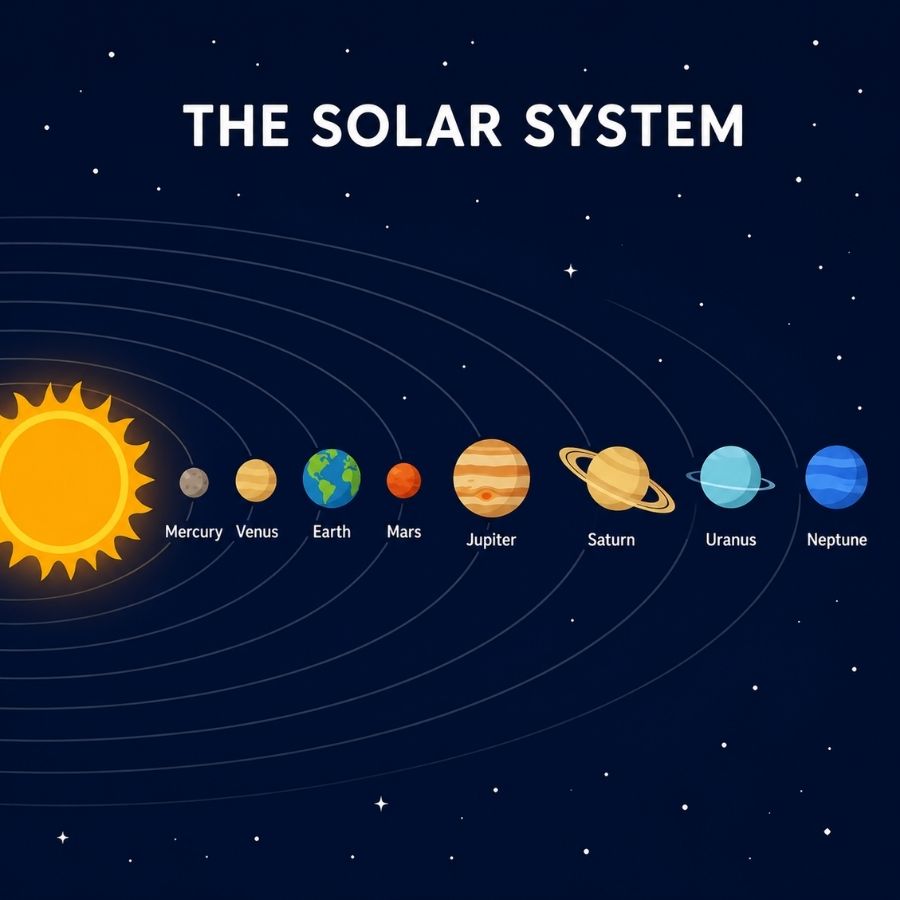
We are learning to describe the structure of Earth and identify the properties of objects in the solar system (MS-ESS1-3).
I can label the four main layers of the Earth (crust, mantle, outer core, inner core). I can name the eight planets in order from the Sun. I can classify examples of matter as solid, liquid, or gas.
🔥
Warm Up
Activate prior knowledge
Earth Layer Quick Draw
Look at the circle on the board. If this is the Earth, where do we live? What do you think is underneath our feet if we keep digging down?
How to run it
Draw a simple circle on the board, point to the outer edge, and ask students where we live and what might be inside. Take 2-3 quick responses.
Students will
Think about what might be inside the Earth, share one idea with a partner, then volunteers share with the class.
💬 Discuss with a partner
Why do you think the inside of the Earth might be different from the surface?
📺 Optional video follow-up
A short video explaining Earth's layers for kids
Find on YouTube
Introduction to Earth's Structure and the Solar System
What are we learning?
Introduction to Earth's Structure and the Solar System
The Earth is made of four main layers, each with different properties. The crust is the thin outer layer where we live. Below that is the mantle, a thick layer of very hot rock. Deeper still is the outer core, made of liquid metal, and at the very center is the inner core, made of solid metal. Our planet Earth is one of eight planets that orbit the Sun in our solar system. We will also learn about the three states of matter: solid, liquid, and gas.
Your lesson journey First, watch the teacher model how to describe the structure of Earth and identify the properties of objects in the solar system (MS-ESS1-3). Next, practise it together as a class. Then, work independently: In the worksheet, you will label a diagram of Earth's layers, write the names of the eight planets in order from the Sun, and sort examples of matter into solid, liquid, or gas categories.
📘
Key Vocabulary
Important words for today's learning
Crust
The thin, solid outer layer of the Earth where we live, made of rock and soil.
Mantle
The thick, very hot layer of rock beneath the crust that makes up most of Earth's volume.
Core
The center of the Earth, made of metal; the outer core is liquid and the inner core is solid.
Planet
A large, round object that orbits a star; there are eight planets in our solar system.
Solid
A state of matter with a fixed shape that does not flow, like ice, rock, or wood.
Liquid
A state of matter that flows and takes the shape of its container, like water, juice, or oil.
i
Learning About the Solar System
Build the knowledge we need for this lesson
The big idea
Our solar system has the Sun and eight planets that orbit it. Mercury, Venus, Earth and Mars are the smaller, rocky inner planets. Jupiter, Saturn, Uranus and Neptune are the much larger outer planets, and the asteroid belt lies between Mars and Jupiter.
The outer planets
Jupiter, Saturn, Uranus and Neptune are farther from the Sun. They are giant planets made mostly of gases or icy materials and have rings and many moons.
The asteroid belt
A wide region of rocky objects orbits the Sun between Mars and Jupiter. It helps mark the division between the inner and outer planets.
Jupiter
Jupiter is the largest planet in the solar system. Its Great Red Spot is a huge storm that has lasted for a very long time.
Main idea
The main idea is describe the structure of Earth and identify the properties of objects in the solar system (MS-ESS1-3).. Students need a clear explanation of what this means before they practise it independently.
👁
Comparing Inner and Outer Planets
Teacher models — watch carefully
Comparing Inner and Outer Planets
Scientists compare planets using the same features each time. Location, composition, size, moons and rings give us evidence for deciding whether a planet belongs to the inner or outer group.
1. Locate the planet
First, check its position. The four rocky inner planets are before the asteroid belt; the four giant outer planets are beyond it.
2. Compare key features
Use the same features for both planets: rocky or gaseous/icy composition, relative size, distance from the Sun, moons and rings.
Worked comparison: Mercury and Jupiter
Mercury is a small, rocky inner planet close to the Sun with no moons. Jupiter is a huge outer gas giant with many moons, faint rings and the Great Red Spot. These features explain why they belong to different groups.
🤝
Let's Try Together
Work through these together as a class
Problem 1
Look at this list: the outer core, the crust, the inner core, the mantle. Which one is made of liquid metal?
Problem 2
Classify these three examples: a metal spoon, milk in a jug, the air you breathe. Which is a solid, which is a liquid, and which is a gas?
💡 Teacher Hint
For problem 1, remember which layer is liquid. For problem 2, ask: Does it have a fixed shape? Does it flow? Does it spread out?
✅ Answer Cues
The outer core is made of liquid metal. • Metal spoon = solid, milk in a jug = liquid, air you breathe = gas.
✏️
Your Turn
Independent practice
Complete the worksheet independently. Label the four layers of the Earth on the diagram. Write the names of the eight planets in order from the Sun. Sort the examples of matter into the correct columns: solid, liquid, or gas.
✅ Success Reminder
Check that you have labeled all four Earth layers, written all eight planet names in the correct order, and placed each example in the right state of matter column.
💡 If you're stuck
If you need help, look back at the diagrams and examples we used. Remember the mnemonic 'My Very Educated Mother Just Served Us Nachos' for planet order.
🚀 Early Finisher Challenge
When you finish, choose one planet and write one interesting fact about it. Then explain why the inner core is solid even though it is the hottest layer.
🎯 Consolidation
Exit Ticket
On your mini-whiteboard, draw a simple circle representing Earth and label the crust and one other layer inside. Then write the name of one planet that is NOT Earth.
Draw, label, and write on your mini-whiteboard, then hold it up so I can check your understanding.
🗂 Science — Worksheet
🖨 Open / Print
Worksheet
✅ Changes saved!